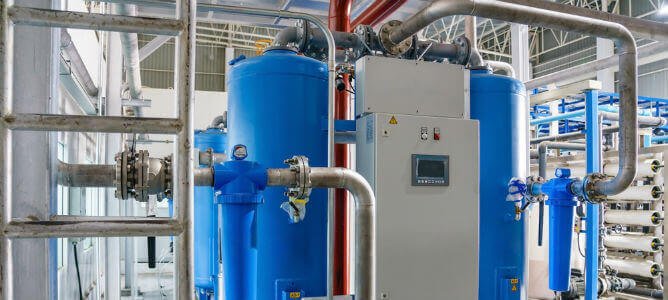
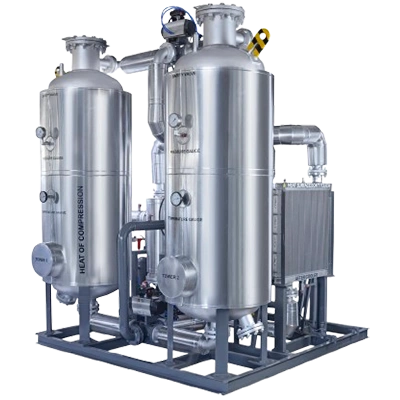
Moisture in compressed air is responsible for an estimated 20–25% of all pneumatic system failures in industrial plants. Water vapour condenses as the compressed air cools in distribution pipes and enters actuators, instruments and process equipment — causing corrosion, valve seat erosion, instrument malfunction, product contamination, and pipe freezing in cold climates. An appropriate air dryer is as essential as the compressor itself.
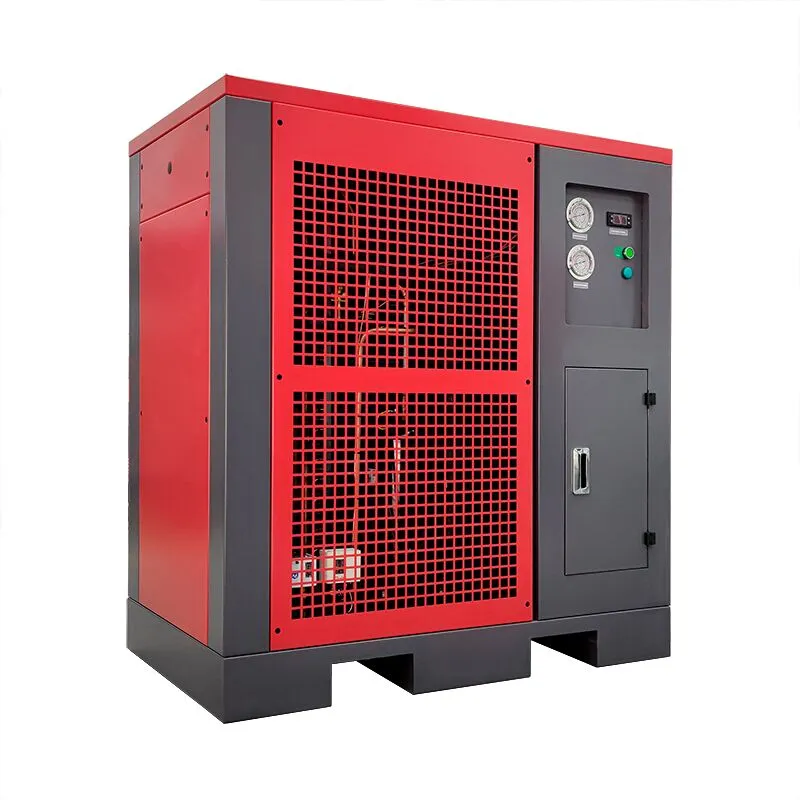
Refrigerated air dryers cool the compressed air to 2–3°C, condensing and separating moisture to achieve a pressure dew point (PDP) of +3°C — suitable for general industrial pneumatics, material handling, packaging and workshop tools. They are the most energy-efficient option for standard industrial applications with COP above 4.0.
Heatless desiccant dryers pass compressed air through a bed of activated alumina or silica gel, adsorbing moisture to achieve PDPs of -20°C, -40°C or -70°C. Required for pharmaceutical manufacturing (GMP), food packaging (no moisture contact), electronic component handling, instrument air systems and outdoor installations in sub-zero climates.
Heat-of-compression (HOC) dryers and externally heated desiccant dryers recover waste heat from the compressor or a heater to regenerate the desiccant — reducing purge air loss from 15% (heatless) to near zero, cutting the effective energy cost of drying by up to 40%. We design the optimal dryer type for each application based on required PDP, flow, inlet conditions and operating economics.

Hot, wet compressed air (typically 35–50°C at compressor outlet) enters the air-to-air pre-cooler, where it is pre-cooled by the outgoing cold air, recovering approximately 60% of the refrigeration duty. The air then passes through the air-to-refrigerant heat exchanger, cooled to 2–3°C by a hermetically sealed refrigerant circuit (R410A or R407C). Moisture condenses and is separated by a centrifugal separator and automatic float drain. The cold, dry air reheats through the pre-cooler before distribution.
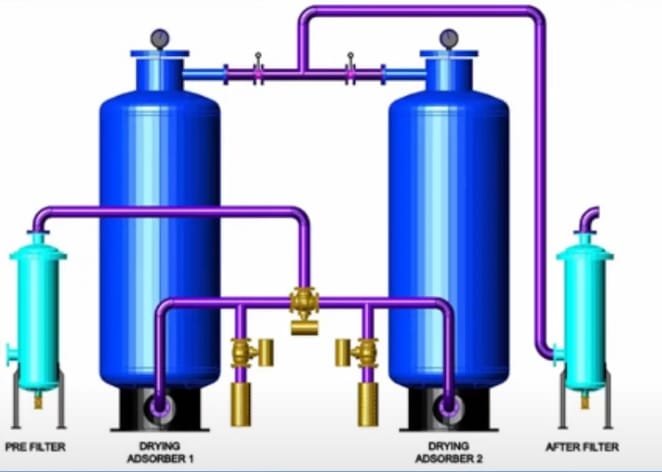
Two towers filled with activated alumina or silica gel desiccant alternate in 5-minute adsorption/regeneration cycles. Tower A receives wet air at line pressure and adsorbs moisture. Simultaneously, Tower B is depressurised and a small fraction (10–15%) of dry product air is purged through the bed in the reverse direction to strip adsorbed moisture and restore adsorption capacity. The cycle then reverses automatically. Consistent outlet PDP of -40°C or -70°C regardless of inlet temperature or humidity.
Available for oil-free rotary screw or centrifugal compressors where the compressed air exits at 150–180°C. This high-temperature air is routed through the desiccant bed first — regenerating it without any purge air loss. The air then passes through an aftercooler and the adsorption bed for final drying. Zero purge loss means 100% of compressed air is available for distribution — the most efficient desiccant drying method.
Suitable for all compressor types, including reciprocating and lubricated screw compressors. An external electric heater or steam coil heats air to 120–150°C for desiccant bed regeneration, while the main compressed air stream is dried in the adsorption tower. Purge air requirement is reduced to 3–5% vs 15% for heatless designs. Desiccant life is extended due to complete thermal regeneration.
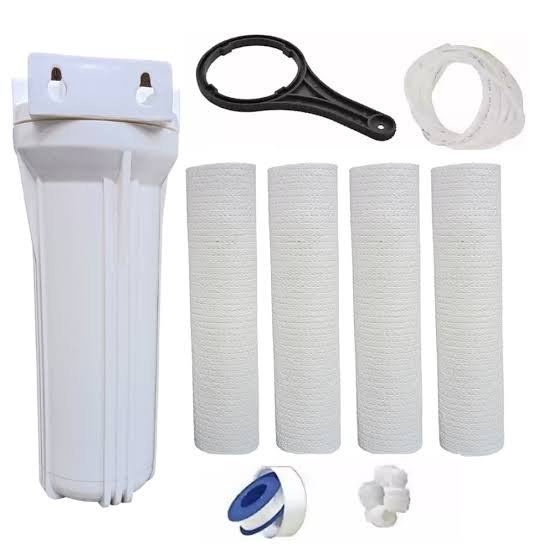
Compressed air quality is defined by ISO 8573-1 Classes for particles (Class 1: <0.1μm), water (Class 1: -70°C PDP) and oil (Class 1: <0.01 mg/m³). Pre-filters (5μm and 1μm) protect desiccant from oil contamination and particulate blinding. After-filters remove desiccant fines generated by attrition. Oil removal coalescent filters achieve <0.01 mg/m³ total oil carryover.
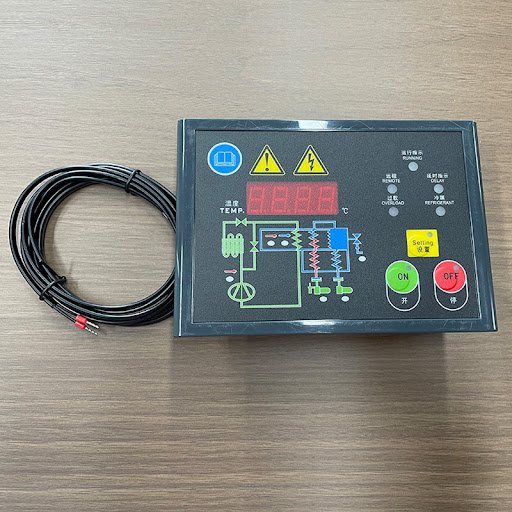
Modern dryers are equipped with dew point transmitters for real-time outlet quality measurement, digital displays and 4-20mA outputs for SCADA integration. Dew point control systems adjust cycle timing based on actual moisture loading, optimising purge air consumption. Remote monitoring with GSM/Ethernet connectivity provides alarms for high dew point, valve failure and filter differential pressure.
| Types Available | Refrigerated / Heatless / HOC / Heated |
| Flow Range | 10 Nm³/hr to 10,000 Nm³/hr |
| Inlet Pressure | 6 to 13 bar |
| Refrigerated PDP | +3°C / +1°C |
| Desiccant PDP | -20°C / -40°C / -70°C |
| ISO Air Purity | Class 1,2,3 to ISO 8573-1 |
| Desiccant Material | Activated Alumina / Silica Gel |
| Desiccant Life | 3–5 years (heatless) / 5–10 yrs (heated) |
| Power | 0.1–2.5 kW (refrigerated) / 0–0.5 kW (heatless) |
| Standards | ISO 8573-1 / CE Mark / PED |
Share your flow rate, required PDP and application details — we will recommend the optimum dryer and estimate energy savings over cylinders within 24 hours.