Zero Liquid Discharge (ZLD) is the highest standard of industrial water management — a system in which all wastewater generated by an industrial process is treated, recycled and recovered, resulting in absolutely no liquid effluent being discharged to the environment. The only output is a dry, solid waste (salt cake or brine solids) that can be safely landfilled or sold as a by-product.
The National Green Tribunal (NGT) and CPCB have mandated ZLD for highly polluting industries including textile dyeing, tanneries, pulp and paper, distilleries, sugar mills, and large-scale power plants. Violation attracts closure notices and heavy penalties. ZLD is also increasingly adopted voluntarily by industries in water-scarce regions to achieve water neutrality.
Our ZLD systems integrate advanced treatment train — biological treatment → ultrafiltration → reverse osmosis (RO) → multiple-effect evaporation (MEE) or mechanical vapour recompression (MVR) → agitated thin-film dryer (ATFD) or spray dryer — achieving total water recovery. The recovered water is of demineralised quality, reusable for boiler makeup, cooling towers and process water.
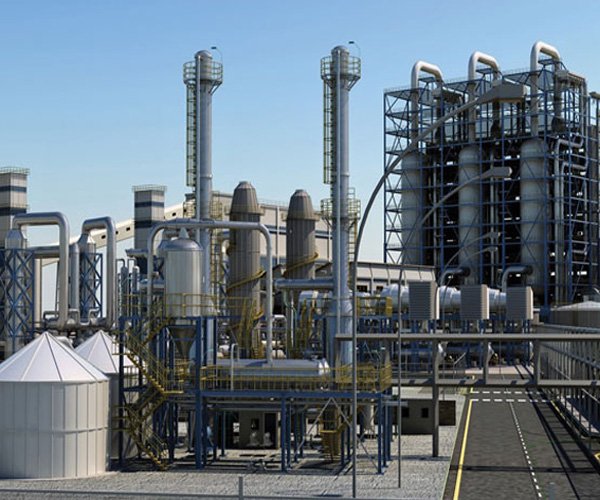
We have successfully installed ZLD systems for textile clusters, pharma API plants, chemical manufacturing units and power plants across Gujarat, Tamil Nadu, Maharashtra, Rajasthan and Punjab — helping clients convert a compliance burden into a competitive water-security advantage.

Conventional ETP/STP pre-treatment removes gross BOD, COD, TSS and oil & grease to safe levels for membrane systems. Biological treatment using MBBR or MBR is essential before reverse osmosis to prevent biofouling. The MBR permeate — with TSS near zero — feeds directly to the RO system, maximising membrane life and reducing chemical consumption.
Hollow-fibre UF membranes with 0.04μm pore size provide absolute removal of suspended solids, bacteria, viruses and colloidal matter before the high-pressure RO stage. UF permeate SDI (Silt Density Index) is maintained below 3, which is the critical threshold for sustained RO membrane performance. CIP (Clean-in-Place) systems automate membrane cleaning cycles.
High-pressure RO systems using thin-film composite polyamide membranes achieve 75–85% water recovery with TDS rejection above 98%. The permeate is reused as process water or for cooling towers. The RO concentrate (reject) — with TDS 10,000–80,000 mg/L depending on feed — is sent forward to the thermal evaporation stage. Anti-scalant dosing prevents calcium carbonate and sulphate scaling.
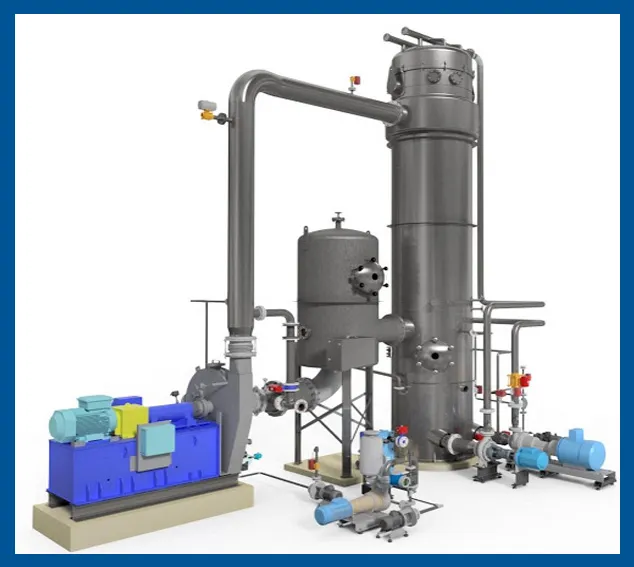
The MEE concentrates the RO reject from 5–8% total dissolved solids to 25–35% using steam from a low-pressure boiler or waste heat recovery. Multiple evaporation effects (3–6 stages) reuse latent heat from each stage as the driving energy for the next, reducing steam consumption by 60–70% compared to a single-effect evaporator. The condensate is pure distilled water, reused in the process.
Mechanical Vapour Recompression (MVR) is the most energy-efficient thermal concentration technology, consuming only 12–18 kWh per tonne of water evaporated — 80% less than MEE. A mechanical vapour compressor raises the pressure and temperature of the evaporated vapour, which is then used as the heating medium for the same evaporation stage. MVR is recommended for plants above 500 KLD concentrate volume.
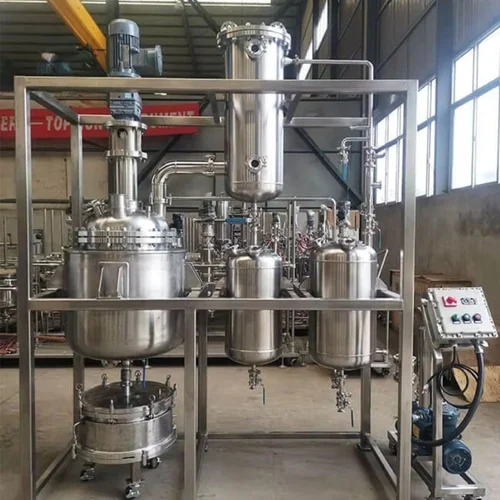
The concentrated slurry from the MEE/MVR at 25–35% solids is fed to the ATFD — the final drying stage. An agitated thin film is maintained on a heated cylindrical surface to achieve rapid evaporation. The outlet is a dry, powdery or granular salt cake at 95%+ dry solids. The ATFD is the most critical and energy-intensive equipment in the ZLD train, requiring precise control.
For certain salt chemistries (sodium chloride, sodium sulphate), a forced-circulation crystalliser produces well-defined salt crystals that can be sold. A spray dryer provides an alternative pathway — slurry is atomised into fine droplets in a hot gas stream (150–250°C), producing a dry, free-flowing powder in seconds. Salt purity above 92% enables marketing as industrial salt.
The condensate from MEE/MVR and ATFD is high-purity distillate, suitable for boiler makeup, DM water applications and critical process uses. Online TDS, conductivity and pH monitoring ensures recycled water quality. A polishing mixed-bed ion exchange unit further treats the distillate for boiler feed water applications. Net water savings of 95–100% of the original fresh water consumption.
| System Capacity | 100 KLD to 5,000 KLD |
| Water Recovery | 95% to 100% |
| Feed TDS | Up to 80,000 mg/L |
| Product Water TDS | <50 mg/L (Distillate) |
| Salt Cake DS | >95% Dry Solids |
| Thermal Efficiency | 3–6 Effect MEE / MVR |
| MVR Energy | 12–18 kWh/tonne water |
| Materials | SS 316L / Duplex / Titanium |
| Automation | DCS / Full PLC-SCADA |
| Compliance | CPCB / NGT / SPCB ZLD Norms |
Our ZLD team provides free preliminary feasibility study, water balance analysis and capex/opex estimates for your project.